

Why Your Generic Resume Is Getting Ignored
You have spent hours crafting a polished resume. You apply to twenty jobs. You hear back from two, maybe three.
The problem is not your experience. It is the resume itself. Specifically, the mismatch between what your resume says and what each job posting is asking for.
Modern hiring operates on two filters before a human ever reads your application:
The ATS filter. Applicant Tracking Systems scan resumes for exact keyword matches against the job description. If your resume says “led cross-functional teams” but the job description says “managed stakeholder alignment,” the system may not connect them, even though they describe the same thing. Many qualified candidates are filtered out before a recruiter sees their application.
The recruiter skim. When a human does review your resume, they spend an average of six to eight seconds on initial screening. They are looking for signals that your background maps directly to their role. A generic resume forces them to do that mapping mentally. Most will not bother.
The solution is to tailor your resume for each application. But doing this manually (reading the job post carefully, identifying the key requirements, rewriting your bullets to reflect the right terminology) takes thirty minutes to an hour per application.
That is why most people do not do it.
What an AI Resume Tailor Actually Does
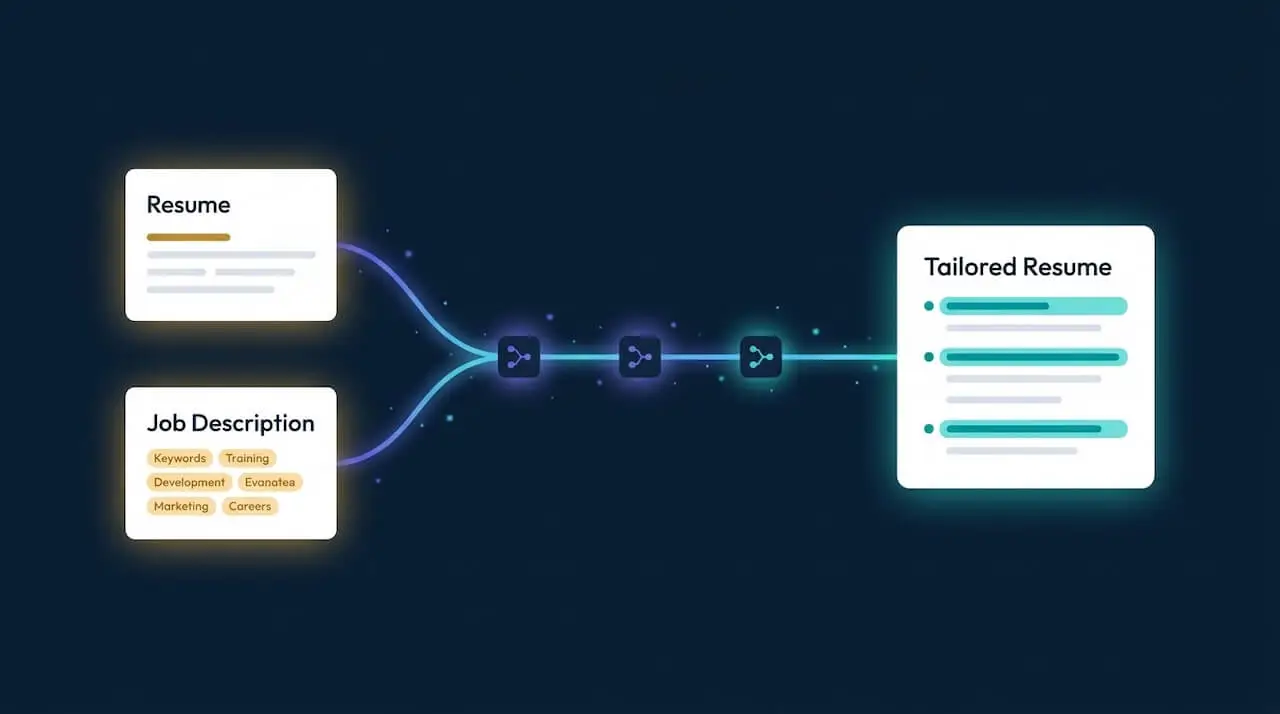
A proper AI resume tailoring workflow does four things in sequence:
-
Analyses the job description to extract required skills, preferred qualifications, keywords, seniority signals, and the tone the company uses.
-
Maps your existing experience against those requirements, identifying what aligns strongly, what needs reframing, and what gaps exist.
-
Rewrites your resume bullets and summary using the job’s language and keyword profile, without fabricating anything. It only reframes what you actually did.
-
Produces a tailored version ready to submit, along with a brief explanation of what changed and why.
This is not about gaming the system. It is about communicating your genuine experience in the language that the role, the team, and the hiring process is looking for.
Mass-Apply Tools vs. Targeted Tailoring: Which Gets You Hired?
There is a growing category of tools that promise to automate your job search entirely. They scan job boards, submit your resume to hundreds of positions automatically, and use AI to generate cover letters in bulk. The pitch is volume: apply to more jobs and the odds work in your favour.
This approach has a fundamental problem that volume cannot fix.
Recruiters can identify a mass-applied resume immediately. Generic framing, mismatched terminology, and cover letters that could apply to any company read as low-effort signals. Many recruiters actively deprioritise applications that look automated. The ATS filter may let them through, but the human filter catches them.
More importantly, mass applying to roles you are not a strong fit for wastes your time and theirs. The interviews you want are with companies where your background genuinely maps to what they need. Getting there requires understanding each role specifically, not blasting a resume at everything that matches a keyword.
The Askimo approach is different. Instead of applying to more jobs, it makes each application significantly stronger. You select the roles you actually want, paste in the job description, and get a resume that speaks the company’s language, addresses their specific requirements, and positions your experience the way a recruiter at that company would want to see it.
The result is not a higher application count. It is a higher response rate from the applications that matter.
If you are applying to roles that genuinely match your background, targeted tailoring will outperform mass-apply every time. Quality beats volume when every application is optimised for a real match.
Why a Single Prompt Falls Short
Most people who try AI resume tailoring do something like this:
“Here is my resume. Here is the job description. Rewrite my resume to match the job.”
This produces mediocre results, and here is why: the AI is being asked to do four distinct cognitive tasks simultaneously (analyse, map, rewrite, and format) with no separation between them. The output tends to be over-optimized (stuffing keywords that do not fit naturally), shallow (generic rewrites that miss role-specific nuance), or inaccurate (hallucinated experience).
What About Reasoning Models?
A natural follow-up: why not just use a reasoning model like o1 or o3 and let it work things out on its own?
Reasoning models are impressive at tasks where the problem and the answer exist in the same space. But resume tailoring is not that kind of task. It involves your knowledge of the role, your judgment about which experiences are worth surfacing, and deliberate sequencing: understand the job first, then map your background against it, then rewrite with that mapping in hand. The model cannot know which of your experiences you consider most relevant, or what you want to emphasise for this particular company.
More importantly, reasoning models do not let you step in. The thinking happens privately, inside the model. You submit a prompt and receive a result. There is no point at which you can say “now that you have read the job description, here is how I want you to interpret my most recent role,” or “treat these three requirements as non-negotiable before you touch the experience section.” The model sequences its own reasoning however it sees fit. You receive whatever it produces.
The difference becomes clear once you have seen both approaches. A single-prompt result, even from a capable reasoning model, tends to over-indexing on keywords and under-delivering on nuance. The rewrite feels like it could apply to several different candidates. A structured multi-step run, where each stage builds directly on the last, produces something that reads specifically: the language maps to the role, the framing reflects your actual background, and the reasoning behind each change is traceable.
That traceability matters. When you can see what the job analysis produced, and how the experience mapping used it, and how the rewrite drew from both, you can intervene at any point. You can correct the mapping before the rewrite runs. You can adjust the job analysis if a requirement was misread. That level of control is not possible when the reasoning is opaque.
The Askimo Resume Tailoring Plan
Askimo Plans run a multi-step AI workflow automatically. You provide two inputs: your resume and the job description. The plan then runs four sequential steps, each with a focused job.
Here is what each step does:
Step 1: Job Analysis The AI reads the job description as a recruiter would: extracting must-have requirements, nice-to-haves, implicit seniority signals, culture keywords, and the specific language the company uses to describe the role. This becomes the foundation for everything that follows.
Step 2: Experience Mapping The AI reads your resume and maps your actual experience against the job analysis. It identifies which of your achievements align directly, which could be reframed to align better, and which requirements you may not be able to address. No fabrication, only honest mapping.
Step 3: Resume Rewrite Using the mapping from Step 2, the AI rewrites your professional summary, skills section, and work experience bullets to reflect the job’s keyword profile and language. Your experience stays factual. Only the framing and terminology shifts.
Step 4: Cover Letter Opener and Submission Notes The AI generates a tailored cover letter opening paragraph (the hardest part to write) and a brief set of notes explaining the key changes made and why, so you can review, adjust, and submit with confidence.
Setting Up the Plan in Askimo
You do not need to write any code or configuration to use this. Askimo includes an AI generation panel in the plan editor. Describe what you want in plain English and the AI writes the full plan for you.
Open the Plans section in Askimo, click New Plan, and type something like:
“A 4-step plan that analyses a job description, maps it against my resume, rewrites my resume to match the role, and generates a tailored cover letter opener.”
Askimo generates the complete plan. You can review and tweak the wording, then save it. From that point on, every job application takes two inputs and a few minutes instead of an hour.
Here is what the generated plan looks like under the hood:
id: resume-job-matchername: Resume Job Matchericon: 💼description: Analyzes a job description, maps your resume to it, rewrites your resume, and generates a tailored cover letter opener.inputs:  - key: job_description    label: Job Description    type: multiline    required: true    hint: Paste the full job description here...  - key: resume_text    label: Your Resume    type: multiline    required: true    hint: Paste your current resume text here...steps:  analyze-jd:    system: "You are an expert technical recruiter."    message: |      Analyze this job description and extract the core requirements, skills, and key responsibilities:
      {{job_description}}  map-resume:    system: "You are an expert career coach."    message: |      Map my resume against the job description analysis.
      Job Analysis:      {{analyze-jd}}
      My Resume:      {{resume_text}}
      Identify matching skills, gaps, and areas for improvement.  rewrite-resume:    system: "You are a professional resume writer."    message: |      Rewrite my resume to better align with the job description, emphasizing the matching skills and addressing the gaps identified.
      Job Analysis:      {{analyze-jd}}
      Resume Mapping:      {{map-resume}}
      Original Resume:      {{resume_text}}
      Provide the completely rewritten resume.  cover-letter-opener:    system: "You are a professional copywriter specializing in career documents."    message: |      Write a compelling, tailored cover letter opener (1-2 paragraphs) for this role based on my rewritten resume.
      Job Analysis:      {{analyze-jd}}
      Rewritten Resume:      {{rewrite-resume}}
      Make it engaging, professional, and highly relevant to the target role.workflow:  type: sequence  nodes:    - type: step      stepId: analyze-jd    - type: step      stepId: map-resume    - type: step      stepId: rewrite-resume    - type: step      stepId: cover-letter-opener
You do not need to write any of this. The AI generation panel in Askimo produces it from a plain-English description.
No YAML Knowledge Required
Askimo has an AI generation panel built directly into the plan editor. You describe what you want in plain English and the AI writes the complete plan for you.
For example, type something like:
“A 4-step plan that analyses a job description, maps my resume against it, rewrites my resume for the role, and generates a tailored cover letter opener.”
Askimo generates the full plan immediately. Review the steps, adjust any wording if needed, and save. Every job application after that takes two inputs and a few minutes.
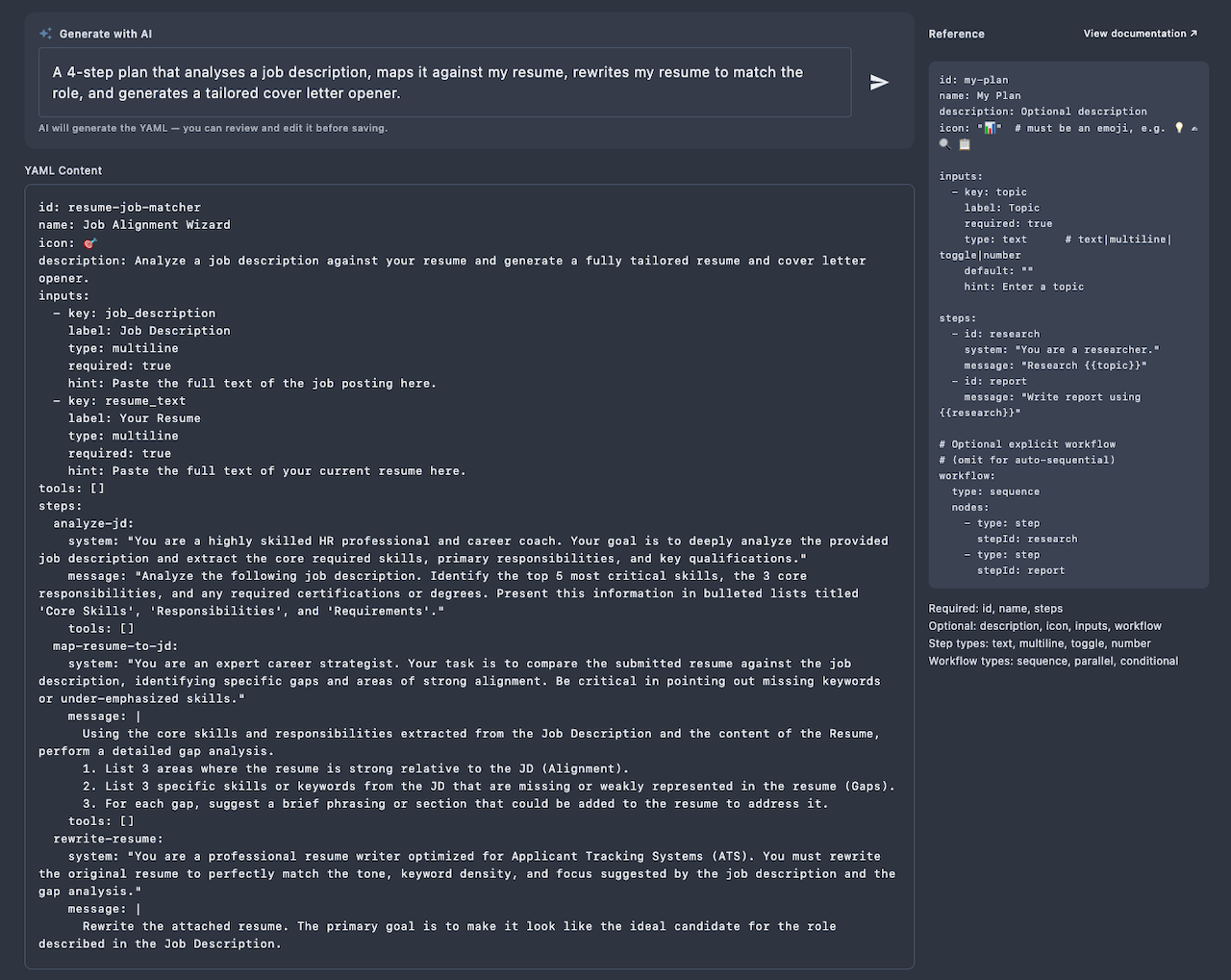
This is what makes Plans practical for everyday job searching. A structured, multi-step tailoring process built from a single plain-English instruction, with no technical knowledge involved.
Note: The quality of the generated plan depends on the model you are using. Stronger models produce more precise step instructions and better placeholder usage. If the generated plan does not quite match what you had in mind, you can edit the YAML directly in the built-in editor. The schema reference panel on the right of the editor documents every field, so manual adjustments are straightforward even without prior YAML experience.
What You Get at the End
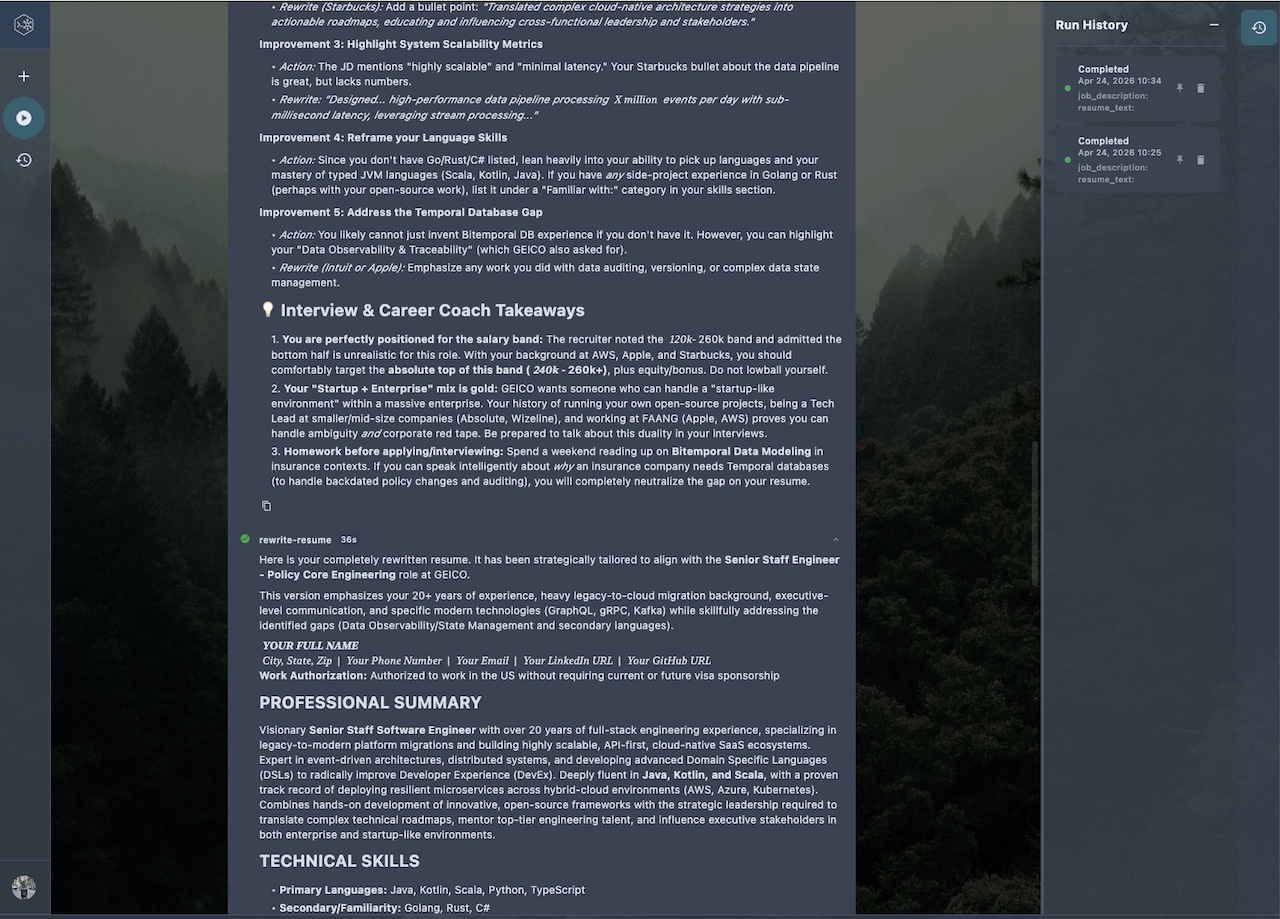
After the plan runs, you have four useful outputs:
Job analysis: a structured breakdown of what the role actually requires, in the company’s own language. Useful on its own for interview preparation.
Experience mapping: an honest assessment of where your background fits, where it can be reframed, and where gaps exist. Helps you decide whether to apply and how to position yourself.
Tailored resume: your resume rewritten to match the role’s keyword profile and language. Ready to copy into your resume document and format.
Cover letter opener and notes: the hardest sentence of any application, done. Plus a clear record of what changed and why, so you can review before submitting.
The whole process takes two to three minutes once the plan is set up.
Refining the Output
After the plan finishes, you can refine any part of it using the Follow-up field. Askimo holds the full context of the run in memory, so you can ask things like:
- “Make the professional summary more concise, two sentences maximum”
- “The third bullet in my most recent job feels forced. Rewrite it more naturally”
- “I also have experience with Figma, add a reference to it where it fits”
- “Rewrite the cover letter opener to be slightly less formal”
Each follow-up updates the output in place. No need to re-run the full plan.
Privacy: Your Resume Stays Private
Your resume contains sensitive personal information: employment history, contact details, compensation context. You should not be pasting it into a web interface you do not control.
Askimo runs locally on your computer. When you use Askimo with Ollama, the entire process runs on your machine with no data leaving it. When you use cloud providers like OpenAI or Gemini, your data is sent to that provider directly, the same as using ChatGPT, but it never passes through Askimo’s servers.
Exporting the Result
When the tailored resume is ready, you can export it immediately:
- Export Result: exports the final step output (tailored resume and cover letter opener) as a PDF or Word (.docx) file
- Export Full Run: exports all four steps in sequence, useful if you want a record of the analysis and mapping alongside the final documents
No formatting required. The document goes from Askimo to a shareable file in one click.
Other Job Search Use Cases
The same multi-step approach works across the job search process:
- Interview preparation: Analyse the job description, map likely interview questions to your experience, and generate prepared answers
- LinkedIn profile update: Map the types of roles you are targeting and rewrite your LinkedIn summary and experience sections accordingly
- Salary research: Research market rates for a role at a specific company and generate negotiation talking points
- Company research: Profile a company before an interview, covering culture, recent news, strategy, and the questions you should ask
Each of these is a separate plan, built in minutes using a plain-English description.
Try It With Askimo
Askimo Desktop is free to download and works with OpenAI, Claude, Gemini, Ollama, and other providers. Plans, AI generation, follow-up conversations, and PDF/Word export are all included.
Download Askimo Desktop and build your AI resume tailor in under five minutes.
The built-in plan library includes several career-related plans to get you started, and you can build your own using nothing but plain English.
Support Askimo on GitHub
Askimo is an open-source project built to help people work more effectively with AI.
If you find Askimo useful, please consider visiting the GitHub repository and giving it a star ⭐. Your support helps the project grow and encourages continued development.